I used to think an expensive-looking room needed an expensive budget. Then I helped a friend redo her rental bedroom with basically nothing but paint, secondhand frames, and a weekend of rearranging, and the result looked like something out of a design magazine. That’s when it clicked: making your room look expensive has almost nothing to do with how much you spend and almost everything to do with how intentional every choice feels.
If you’re chasing that soft, polished, put-together look (the kind where guests ask who your designer is), you don’t need a renovation. You need to know which small changes actually move the needle. Below are 30 ways to make your room look expensive, broken into categories so you can pick what fits your space, your budget, and your personal style of girly room decor.
Start With What’s Already Working Against You
Before you add anything, it helps to understand why some rooms feel cheap even when the furniture itself is nice. Usually it’s clutter, mismatched tones, or lighting that’s too harsh or too flat. Fixing these first makes every other tip on this list hit harder.
1. Edit before you decorate
Walk through your room and remove anything that doesn’t serve a purpose or bring you joy. A room crammed with stuff, even cute stuff, reads as cluttered and cheap. Expensive rooms have breathing room. Pack away a third of your decor and see how different the space feels immediately.
2. Fix your lighting temperature
Harsh white overhead lighting is one of the biggest reasons a room feels like a dorm instead of a boutique hotel. Swap your bulbs for warm white (around 2700K to 3000K) and add a lamp or two at different heights. Layered, warm lighting instantly softens a space.
3. Get rid of visible cords and clutter zones
Nothing says “budget” like tangled cords hanging off a nightstand. Use cord clips, a small basket, or a cable sleeve to tuck them away. It’s a five-minute fix that changes how polished your whole setup looks.
Also read: 20 Cute Bedroom Ideas for Women and Girls
Color and Texture Do the Heavy Lifting
This is where a lot of the “expensive” feeling actually comes from. It’s not about buying pricier items, it’s about how colors and textures work together.
4. Stick to a tight color palette
Pick two to three main colors and one accent, then commit. Rooms that look expensive rarely have five competing colors fighting for attention. A palette like cream, sage, and warm wood, or blush, white, and brass, feels curated instead of random.
5. Add texture, not just color
Flat, matte everything can feel a little lifeless. Mix in texture through a woven throw, a fluffy rug, linen curtains, or a ribbed vase. Texture is what makes a neutral room feel rich instead of boring.
6. Paint one accent wall in a moody or deep tone
You don’t have to paint the whole room. One wall in a deep terracotta, sage, or dusty plum makes the space feel designed rather than default. Renters can use peel-and-stick wallpaper for the same effect without touching the actual wall.
7. Match your metals
Mixing gold cabinet handles with silver lamp bases and black picture frames creates visual noise. Pick one metal finish (brass, matte black, or brushed nickel) and use it consistently across hardware, frames, and light fixtures.
Furniture Placement and Proportion
You’d be surprised how much of the “expensive” look comes down to spacing and scale rather than the furniture itself.
8. Float your furniture away from the walls
Pushing everything against the wall is a common habit, but it often makes a room feel smaller and less intentional. Pulling your bed or dresser even a few inches out, or angling a chair, creates a sense of flow that reads as designed.
9. Go bigger with your art
Small, scattered frames on a big wall can look like an afterthought. One or two large-scale pieces (or a tightly grouped gallery wall with consistent framing) makes a much bigger visual impact for often less money than a dozen small prints.
10. Hang curtains higher and wider than the window
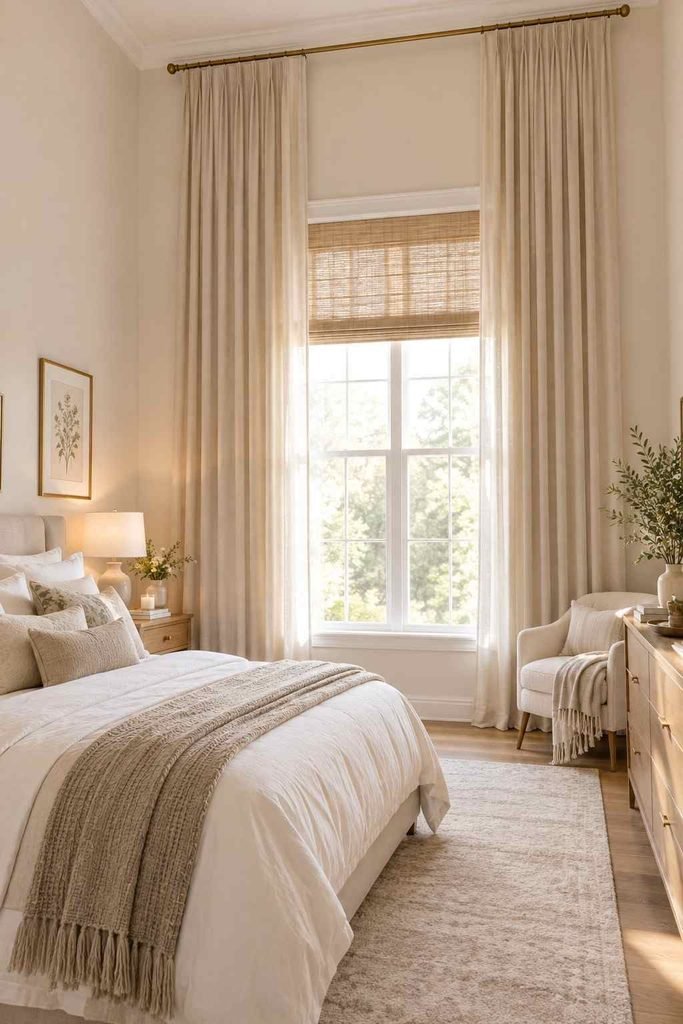
This is one of the single best girly room decor tricks for making a room look expensive. Mount your curtain rod close to the ceiling and extend it a few inches past the window frame on each side. It tricks the eye into thinking the window, and the ceiling, is taller than it is.
11. Choose furniture with legs
Furniture that sits flush on the floor can make a room feel heavy and boxed in. Pieces with visible legs let light pass underneath, which makes the whole room feel airier and more elevated.
Small Details That Punch Above Their Price
This is the category people underestimate the most. These are cheap, fast changes with a disproportionately expensive-looking payoff.
12. Upgrade your throw pillow covers
You don’t need new pillows, just new covers in a nicer fabric like linen or velvet. Pick two coordinating patterns or textures instead of five random ones.
13. Style your nightstand like a hotel would
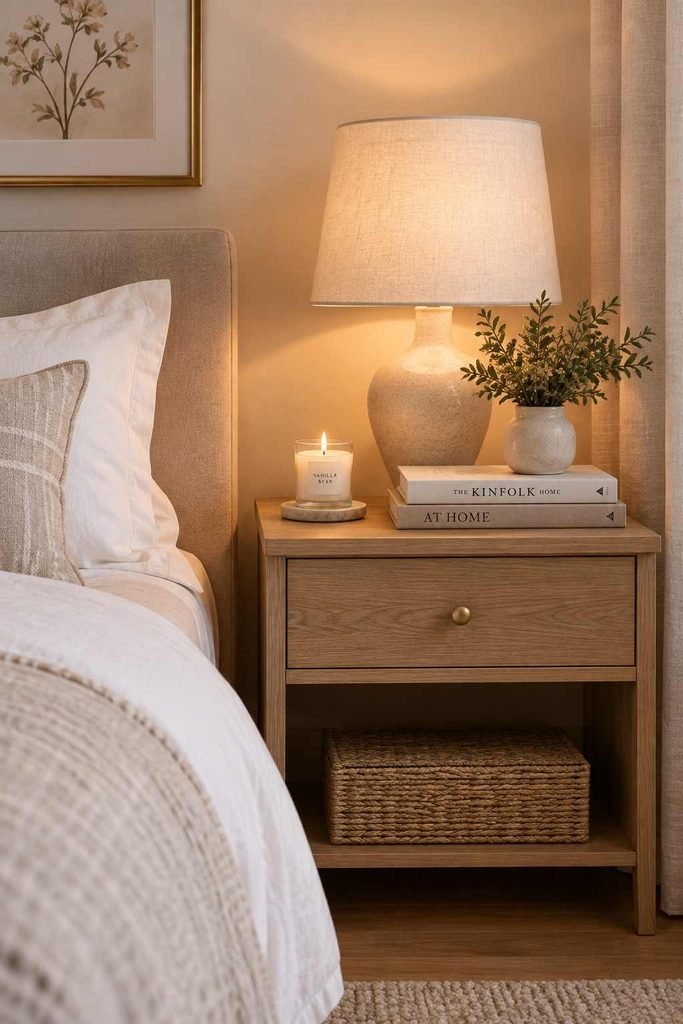
A lamp, a small stack of books, and one decorative object (a candle, a small vase, a trinket dish) is enough. Anything more starts to look cluttered.
14. Add a table lamp with a fabric shade
Fabric shades diffuse light more softly than plastic or metal ones and instantly feel more high-end. Look for a linen or pleated shade in a neutral tone.
Shop from Amazon
15. Swap plastic hangers for wood or velvet ones
If your closet is visible or your door is often open, this tiny swap makes a noticeable difference. It also protects your clothes better.
16. Use a tray to corral small items
Perfume bottles, jewelry, or skincare scattered across a dresser look messy no matter how nice each item is on its own. Group them on a tray and the same items suddenly look styled.
17. Add fresh or faux greenery
A little bit of green softens hard edges and adds life to a room. If real plants aren’t your thing, a well-made faux stem or two in a simple vase does the job just as well.
18. Layer your rug
Placing a smaller textured rug on top of a larger neutral one adds depth and makes the floor feel more finished, especially over cheap flooring or carpet you can’t replace.
Fabric, Bedding, and Softness
Your bed usually takes up the most visual real estate in the room, so it deserves extra attention.
19. Invest in one really good duvet cover
You don’t need a whole new bedding set, just one quality cover in a solid neutral or subtle pattern. Crisp, well-fitted bedding reads as expensive even on an older mattress.
20. Add a bed skirt or make sure nothing is visible underneath
An unmade-looking gap under the bed, especially with storage boxes peeking out, undercuts an otherwise nice setup. A simple bed skirt hides all of that in one move.
21. Layer your bedding like a hotel
Fitted sheet, flat sheet or duvet, then a folded throw at the foot of the bed, then two to four pillows in varying sizes. This layered look is one of the fastest ways to make a bed, and by extension the room, look put together.
22. Choose curtains in a heavier fabric
Thin, sheer curtains can look a little flimsy on their own. If budget allows, go for a heavier linen or cotton blend, or layer a sheer under a heavier panel for that soft, expensive drape.
Wall and Ceiling Tricks
Most people only think about their walls at eye level, but the space above and around them matters too.
23. Add crown molding with peel-and-stick trim
You can now get lightweight, paintable trim that mimics real crown molding without any construction. It adds an architectural detail that instantly makes a room feel custom-built instead of builder-basic.
24. Frame a mirror instead of leaving it bare
A plain mirror is fine, but a framed one (even a cheap frame you DIY around an existing mirror) looks significantly more finished and adds another reflective surface to bounce light around the room.
25. Use picture ledges instead of nails for a gallery wall
Ledges let you layer and rearrange frames easily, which gives that curated, evolving look you see in design magazines, rather than a static row of nailed-up prints.
Scent, Sound, and the Senses
This part gets overlooked constantly, but it plays a real role in how “expensive” a room feels the moment you walk into it.
26. Give the room a signature scent
A quality candle or reed diffuser in a warm, subtle scent (not overpowering) adds a sensory layer that makes people associate the room with a boutique or spa. Avoid anything too sweet or artificial-smelling.
27. Keep surfaces dust-free and glass streak-free
This sounds basic, but a dusty lamp base or a smudged mirror undercuts every other design choice you’ve made. A five-minute wipe-down before you take photos or have guests over makes a real difference.
Personal Touches That Still Look Polished
An expensive-looking room isn’t a sterile hotel room. It should still feel like you. The trick is choosing personal touches that are curated rather than cluttered.
28. Display one or two meaningful objects, not twenty
A single sentimental item, styled well, has more impact than a shelf packed with knickknacks. Choose your favorites and store the rest.
29. Frame your own photos with intention
Instead of a cluttered corkboard, pick your three or four favorite photos and frame them in matching frames. It’s the same personal touch, just presented in a way that looks designed rather than thrown together.
30. Add one statement piece that reflects your taste
This could be a bold lamp, a patterned chair, or an oversized piece of art. One well-chosen statement piece gives the whole room a focal point and makes it feel like a deliberate design choice rather than a collection of random purchases.
Putting It All Together
The truth is, no single tip on this list will transform your room on its own. What actually makes a room look expensive is the layering of several small, intentional choices: warm light, a tight color palette, matched metals, good fabric, and a little bit of editing. Pick five or six ideas from this list that feel most doable for your space and budget, start there, and build from it over a few weekends.
Girly room decor doesn’t have to mean sparkly and over-the-top. Some of the most expensive-looking girly rooms are actually the most restrained ones, where every soft color, every texture, and every little object earns its place. That restraint is the real secret. Once you start editing with intention instead of just adding more, your room starts to look like it belongs in a magazine, no renovation required.