There’s a particular kind of living room that makes you want to kick your shoes off the second you walk in. Soft light, a couch that actually looks like it wants to be sat on, maybe a blanket draped just right over the arm. That’s the feeling most of us are chasing when we start pulling together living room ideas, and honestly, it’s more achievable than people think. You don’t need a big budget or a total gut renovation. You need a handful of smart choices that work together.
This list pulls together 30 living room ideas that focus on two things at once: comfort and style. A lot of design advice picks one or the other. Either it’s all about the “look” (gorgeous photos, impossible to actually live in) or it’s all about coziness with zero personality. The goal here is the sweet spot in between, the kind of room that photographs well and also feels like home after a long day.
Start With Layout, Not Decor
Before you buy a single throw pillow, look at how your room is arranged. This is the part people skip, and it’s the part that matters most.
1. Float your furniture away from the walls. Pushing every piece against the wall is a habit most of us picked up without thinking about it, but it usually makes a room feel more sparse and less inviting. Pulling your sofa even a foot or two off the wall, and adding a console table or a slim bookshelf behind it, creates a sense of layered depth.
2. Create a real conversation area. Arrange seating so people can actually talk to each other without twisting their necks. Two chairs angled toward a sofa, with a coffee table in the middle, does more for the “cozy” factor than any candle ever will.
3. Don’t let the TV run the room. It’s fine to have a TV, most living rooms do, but if every chair in the room points at a black screen, the space reads as a media room, not a living room. Angle at least one seat toward a window or a fireplace instead.
4. Use rugs to define zones. In open-concept spaces especially, a rug tells your eye “this is the living room part” versus the dining area or the hallway. As a rule of thumb, front legs of your furniture should sit on the rug, not floating off the edge.
5. Leave breathing room for walking paths. A room can be full of nice things and still feel wrong if you’re constantly squeezing between furniture. Aim for at least 30 inches of clear path between major pieces.
Cozy Living Room Ideas That Actually Work
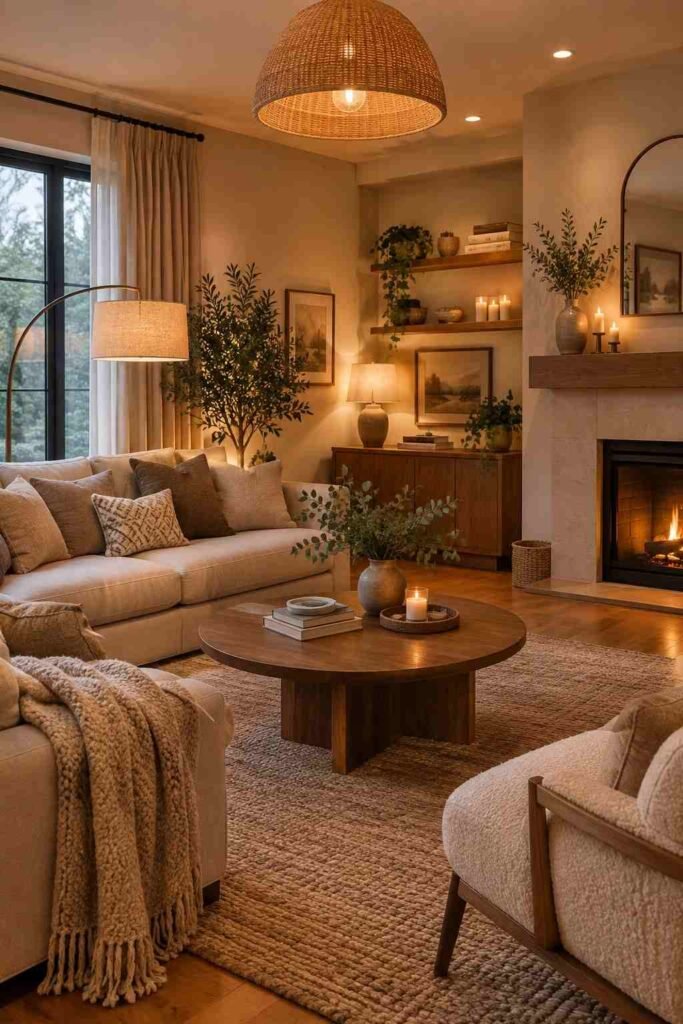
If your priority is warmth over anything else, these cozy living room ideas are where to start.
6. Layer your lighting. One overhead light is the fastest way to make a room feel like an office. Mix in table lamps, a floor lamp, and maybe string lights or a dimmable fixture. Warm-toned bulbs (around 2700K) make a huge difference over the cool white ones many homes default to.
7. Add texture through textiles. A chunky knit throw, a few pillows in mismatched-but-coordinated fabrics, a soft area rug underfoot. Texture is what separates a cozy room from a merely tidy one.
8. Bring in a reading nook. Even a single armchair with a small side table and a lamp can become the spot everyone fights over. It doesn’t need its own corner of the house, just a defined little pocket of the room.
9. Don’t skip the coffee table styling. A tray with a candle, a stack of books, something green. It sounds small, but an empty or cluttered coffee table changes the whole mood of the room.
10. Use curtains that actually reach the floor. Short curtains that stop above the windowsill make a room feel stiff. Full-length panels, even simple ones, add softness and make ceilings look taller by association.
11. Add a fireplace element, real or not. If you have a working fireplace, lean into it as the room’s anchor. If you don’t, an electric insert or even a few thick candles grouped on a mantel-style shelf can borrow some of that same warmth.
12. Let plants do double duty. Beyond looking nice, greenery softens hard lines in a room, like the edge of a bookshelf or a bare corner. A large floor plant near a window fills empty space without adding clutter.
Also read: 25 Modern Bedroom Ideas for a Relaxing Space
Living Room Ideas for Small Spaces
Small living rooms need a slightly different approach. The goal isn’t to shrink your ambitions, it’s to be smarter about scale.
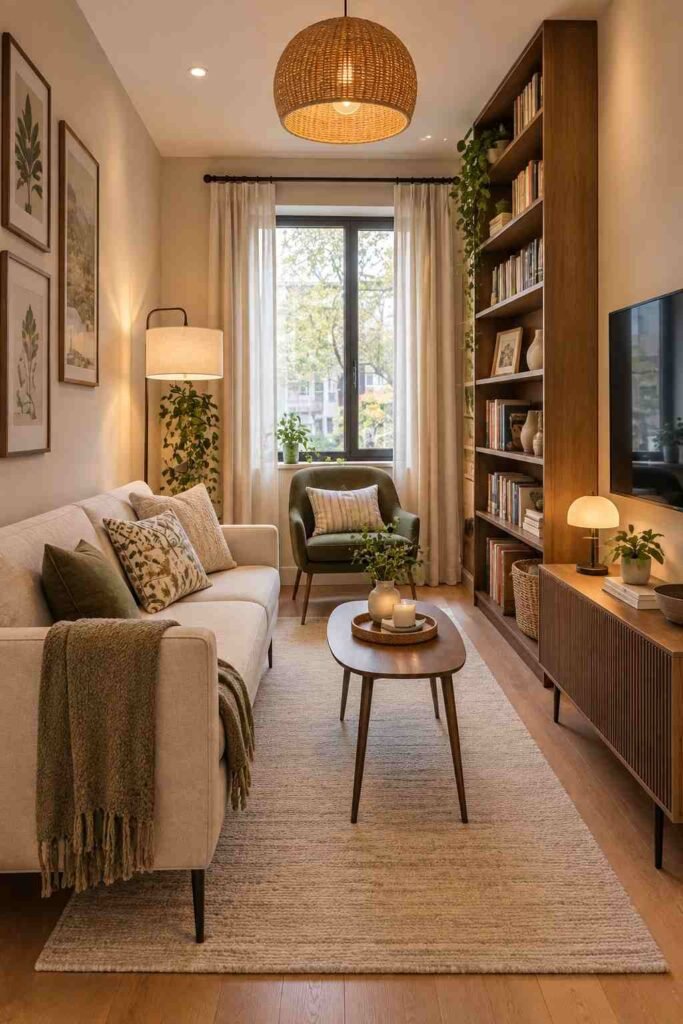
13. Choose furniture with visible legs. Sofas and chairs that sit flush to the floor block sightlines and make a room feel heavier. Pieces with slim, visible legs let light pass underneath, which reads as more open space even when the square footage hasn’t changed.
14. Mirror the light. A well-placed mirror across from a window bounces natural light back into the room. This is one of those simple living room ideas that gets repeated a lot because it genuinely works.
15. Go vertical with storage. Tall, narrow bookshelves use wall space instead of floor space. A small room with a 7-foot bookshelf often feels bigger than the same room with a low, wide one.
16. Pick one or two anchor colors. Too many competing colors in a small space reads as visual noise. Keep walls, large furniture, and rugs in a similar tonal family, then let smaller accessories bring in personality.
17. Multi-purpose furniture earns its keep. An ottoman with storage inside, a coffee table that lifts up into a desk, a bench that doubles as extra seating when guests come over. In a small room, every piece should work harder than one job.
18. Skip the oversized rug debate. Just size up. Counterintuitively, a rug that’s slightly too big for a small room looks more intentional than one that’s too small and floats awkwardly in the middle.
Stylish Touches That Elevate the Whole Room
Once the bones of the room are right, the details are what make it feel finished and a little more editorial.
19. Gallery walls beat single statement art (usually). A cluster of smaller framed pieces, photos, prints, even textile art, feels more collected and personal than one large canvas centered over the sofa.
20. Mix metals, don’t match them. A brass lamp next to a black metal side table isn’t a mistake, it’s how a lot of professionally styled rooms actually look. Matching every metal finish in a room tends to feel a bit showroom-flat.
21. Bring in one unexpected material. Rattan, stone, aged wood, something with a bit of texture and history to it. It breaks up a room that’s otherwise all soft fabric and flat paint.
22. Style your bookshelves like a designer would. Stack some books flat, some upright, mix in a small plant or object here and there. Fully alphabetized, uniform shelves look more like a library than a home.
23. Choose one statement piece and build around it. A bold armchair, a patterned rug, a striking piece of art. Pick one thing you genuinely love and let the rest of the room support it rather than compete with it.
24. Add a console table behind the sofa if you have the depth. It’s a small addition, but it gives you a surface for lamps, books, or a vase, and it fills what’s often dead space.
Color and Wall Ideas Worth Considering
25. Warm neutrals photograph and live better than stark white. Think warm greige, soft terracotta-adjacent tones, or a muted olive. These colors read as cozy in person and don’t feel clinical the way bright white walls sometimes can.
26. Try one accent wall, but pick the right one. The wall behind the sofa or the one you see first when you walk in tends to work best. A poorly chosen accent wall, like one interrupted by a doorway, can look more like an accident than a design choice.
27. Don’t underestimate ceiling color. Painting a ceiling a soft, warm white (rather than bright white) can make a room feel more enclosed and cozy, especially in the evening.
28. Wallpaper in moderation still counts. A single wallpapered wall, or even wallpaper inside a built-in shelf, adds pattern without overwhelming the room the way four wallpapered walls might.
Finishing Touches
29. Scent matters more than people give it credit for. A candle or diffuser with a warm, low-key scent (think vanilla, sandalwood, something soft) adds to that “cozy” feeling in a way that’s easy to underestimate.
30. Personal objects make a room feel lived-in. A framed photo, a souvenir from a trip, something a little imperfect and yours. Rooms that look like they came straight out of a catalog often feel colder than ones with a few personal touches mixed in.
Bringing It All Together
You don’t need to do all 30 of these at once, and honestly, you probably shouldn’t. Pick a few that solve the actual problems your room has right now. If it feels sparse, start with layout and lighting. If it feels cluttered, focus on storage and one strong color story instead of five competing ones.
The best living rooms aren’t the ones that look perfect in a single photo. They’re the ones that still feel good three years later, after the pillows have gone a little flat and the coffee table has a few water rings on it. That’s usually the sign you got the room right in the first place.
Pingback: 30 Best Girly Bedroom Ideas for a Cozy Space